Showing posts with label gems. Show all posts

Saturday, November 27, 2010

Cut and Shape of Gems

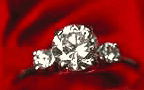
A gem’s shape refers to the face-up outline displayed by the cut of a particular gemstone. In nature, the shape of a gemstone is determined by its natural crystal structure and the conditions under which the crystal developed. To enhance the natural beauty of the crystal and provide suitable shapes for mounting, gem cutters form flat, symmetrical planes, called facets, which catch and reflect light to emphasize preferred colors, sparkle, and brilliance of the finished stone. In addition, gem cutters try to select shapes and cutting styles which allow them to minimize the appearance of undesirable flaws and to get the maximum weight from the rough gem material. The most common shapes include round, oval, square, triangle, pear, marquise, heart, and cushion. With diamonds, shapes other than round are often referred to as fancy cuts.


Round Cut
Round Shape
Square Cut
Square Shape
Cushion Cut
Cushion Shape
Trillion Cut
Trillion Shape
Oval
Oval Shape
Heart
Heart Shape
Marque
Marque Shape
Fancy
Fancy Shape
Pear
Pear Shape
Octagon
Octagon Shape
Half-Moon
Half-Moon Shape
Hexagon
Hexagon Shape


Cutting Style


Cutting style refers to the way in which a gemstone is cut or faceted. Gemstone cutting is based on science. Each gem material has a known refractive index which allows a gem cutter to determine how light rays will bend as they pass through the stone. Using this information a gemstone can then be precisely shaped to best enhance its natural beauty.

The styles of gem cuts are generally divided into faceted gems (gems with geometrically shaped flat polished faces) and non-faceted gems (those gems that do not have geometrically shaped flat polished faces such as cabochons). The most common and basic cutting styles are as follows:

Cabochon Cut

Antique Jewelry Has a dome-shaped top that is polished but un-faceted. The term comes from a French word signifying a bald pate (caboch, from the Latin cabo, meaning a head). Opaque, asteriated, iridescent, opalescent, or chatoyant stones are usually cut en cabochon. The back of a normal cabochon-cut stone is flat, but it may be hollowed to lighten the color. This is the simplest cut for a stone and is often seen in antique jewelry. Since the cabochon is the simplest style and often made from lower quality material that is unsuitable for faceting, it generally costs less than faceted stones.


Step Cut

Has rows of facets that resemble the steps of a staircase. A step cut gem has sloping, four-sided elongated facets that are cut below the table and run parallel to the stone’s girdle. There are fewer facets in a step cut diamond than in a brilliant cut stone. The baguette, a square-cornered, rectangular stone is an example of a step cut. If step cuts have clipped-off corners, they’re called emerald cuts because emeralds are often cut this way. This protects the corners and provides places where prongs can secure the stone.


Diamond Brilliant

Brilliant Cut

Brilliant Cut Has mostly 3-sided facets which radiate outward from the stone and are positioned so that the light coming through them interplays in such a way to best enhance the stone’s brilliance. Kite- or lozenge-shaped facets may also be present.

The best-known example is the full-cut round brilliant, which has 58 facets. Ovals, pears, marquises, and heart-shapes can also be brilliant-cut. The single cut, which has 17 or 18 facets, is another type of brilliant cut. Square brilliant cut stones are called princess cuts. Triangular brilliant cuts are called trilliants. Gemstone pendants or earrings are occasionally cut as briolettes. These have a tear-drop shape, a circular cross-section, and brilliant-style facets.


Mixed Cut

Mixed cuts include faceting elements from both the brilliant and step cut techniques, either side by side or in different areas of the gemstone. Mixed cuts are popular for colored gemstones.

Fancy cut generally refers any cut which is not a standard cabochon, brilliant cut, or step cut. A very common old-style fancy cut is the rose cut which has brilliant-style facets, a dome-shaped crown, a flat base and a round girdle outline. Rose cut may also be cut with a pavilion. Other common examples of fancy cuts are the checkerboard cut which is step- and brilliant-cut with a large table facet on the crown. Another example is the millennium cut which has a step-cut crown and a pavilion with concave faceting.

Antique Cushion Cut
Antique Cushion
Baquette Cut
Baguette
Emerald Cut
Emerald Cut
Briolette Cut
Briolette
Pear Cut
Pear Cut
Common Cuts Marquise Cut
Marquise Cut
Square Cut
Square Cut
Trilliant Cut
Trilliant Cut
Round Cabochon Cut
Round Cabochon
Princess Cut
Princess Cut


Evaluating a Well-Cut Gemstone


Cut quality refers to the proportions and finish of the gemstone. This is a crucial factor because it affects the brilliance and color of gems, but its importance is not always reflected in the price of colored gemstones. Our Todaygem.com gemologists have put together a couple of handy tips to help you quickly evaluate a gemstone’s quality.
  1. View your gemstone face up and see whether it exhibits even color distribution all across the stone. Well-cut stones do not display large black areas or any washed out areas that allow you to see right through them. In general, the larger the window, the poorer the cut. Even color distribution is normally a sign of good quality cut.
  2. Examine the entire shape of the gemstone and consider it to its carat weight. If you were to compare two stones with the same face-up size, the one that has a deeper and fatter bottom will weigh considerably more than a well-cut stone with a more shallow bottom. The overly deep stone would potentially cost more, even though it has the same face-up size; however, it may be impractical for mounting and appear overly dark.

Coral

Coral may not be seen as a real gem by some, but it has fantastic healing qualities.The coral is the gemstone of the planet Mars and helps to overcome problems related to this planet.
Red coral is useful as jewelry and for pleasing the planet Mars, but the use of white corals is more popular in Bengal, where people also use it for Mars energy. 

The best gem should have the following qualities:
1. deep red color
2. regular shape and even surface
3. round or oval shape
4. free of dents, holes, or perforations
5. smooth
One who wears or possesses such coral enjoys good fortune and is never possessed by evil spirits or bothered by ghosts, bad vibrations, nightmares, storms, or lightning. Japa done with a coral mala with 108 beads brings siddhi (power).
Some tests for Identification of Real Coral
1. If real coral is placed in a glass of cow's milk, the color of the milk will appear pink or take on a red tinge. Imitation coral will not affect the whiteness of milk.
2. If a coral is dropped in blood, blood will thicken around it.
3. A true coral changes color according to the physical well-being of the wearer. It fades before the disorder in physical health is noticeable and resumes its original color when physical health is restored.
Some aspects of the Rituals for Wearing a Coral
A coral should be bought on a Tuesday when the Moon is in Aries or Scorpio. The coral's weight should be no less than 6 rattikas. The metal used should be a mixture of copper and gold.
Some aspects of the The Medicinal Utility of Coral
Coral Oxide is used ror different diseases with different mediums, follows:
1. For dry cough: Use it with powdered raw sugar.
2. Cough with mucus: a) If the mucus needs to be expelled from the system, coral oxide should be taken with powdered brown sugar; b) If the mucus needs to be dried, it should be taken with honey.
3. Low fever: It should be taken with sitopiladi choorna with honey.
4. Breathlessness with low fever: Take it with honey.
5. New fever: With honey.
6. Bone fracture: With honey.
7. Eye troubles (burning, irritation): Use it with ghee, rock sugar candy, and milk.
8. Headache: Use it with milk cooked with almond paste.
9. Mental weakness: Use it with milk cooked with almond paste.
10. General tonic: Use it with honey.
11. Diseases of liver: With honey.
12. Hyperacidity: With cold milk.
...
The other form of medical preparation is pishthi (paste), which is more powerful and better in quality than oxide.
Dosage: 1 to 2 rattikas twice a day :
1. To prevent miscarriage: Apply the paste (not powder - if only the powder is available make a paste by adding rose water or kewra water - a few drops to two doses) to the navel of a pregnant woman.
2. First stage of tuberculosis: Use it with honey.
...
Coral powder is very good for nursing mothers who become weak during the nursing period.
Chief Sources of Coral
Coral of the finest quality is obtained in bulk from the coasts of Algeria and Tunisia. Other profitable sites for coral deposits are the coasts of Spain, France, Corsica, Sardinia, and Sicily. Corals are also processed in India.

Blue Sapphire, Amethist

Known as indra neel and neel mani in Sanskrit and neelam in Hindi, the blue sapphire is a gem of the corundum family. The blue sapphire is the gemstone of the planet Saturn and helps to overcome problems related to this planet.
Sometimes white sapphires, rubies and blue sapphires are found in the same mine and that is why there is a mixture of colors in the crystals of these gems. Ruby is harder than white sapphire and blue sapphire is harder than ruby. What distinguishes them from each other is their hardness. Blue sapphire is hardest. Blue sapphire crystals are found as twelve-sided prisms.
Some Qualities of a Good Blue Sapphire
1. smoothness
2. transparence
3. uniformity in color
4. high specific gravity
Some Flaws of a Blue Sapphire
1. milky - brings poverty
2. dull (without luster or devoid of brilliance) - harms friends, brothers and near relations
3. film like a cobweb - brings disease
4. multicolored - increases anxiety and mental problems
5. greenish in shade - causes financial loss
Some tests for Identification of Real Blue Sapphires
1. A real blue sapphire emits blue light and, if placed in a glass of cow's milk, the milk appears to have a bluish tinge.
2. A real blue sapphire emits blue sparks when placed in a glass of water.
Some aspects of the Rituals for Wearing a Blue Sapphire
A blue sapphire should be bought on a Saturday when Saturn is posited in Capricorn, Aquarius or Libra. The weight should not be less than 4 rattikas. Weighing 5 carats is supposed to be auspicious. The gem should be flawless.
The gemstone should be bought in the evening hours and given to the jeweler on the same day, who should prepare a ring from a mixture of gold, iron and silver. For Saturn the following mixture of five metals is best: 1 part gold, 2 parts silver, 3 parts lead, 4 parts iron and 1 part copper. Instead of copper, zinc can be used.
The ring should be taken from the jeweler on a Saturday evening, and the best time to wear the ring is evening.
Saturn is a friend of Mercury and Venus. To add additional power to the ring, emerald and diamond could also be embedded in it. The back should be open to allow the gemstone to touch the skin.
Some aspects of the Medicinal Utility of the Blue Sapphire
Blue sapphire pishthi (paste) can be given for skin diseases, migraine, heartburn, nervous disorders, rheumatism, colic pains, lack of appetite and bloating of the stomach, among others.
Chief Sources of Blue Sapphires
Kashmir, Salem, Burma, Thailand, Sri Lanka

Cat's Eye

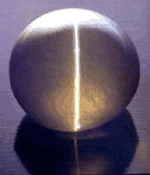
Cat's-eye is a gemstone that comes from the gem mineral chrysoberyl. The cat's eye is the gemstone of the planet Ketu and helps to overcome problems related to this planet.
Cat's eye is an aluminate of beryllium having traces of oxide of iron and chromium, which serve as coloring agents and give it brownish and greenish tinges. The chrysoberyl mineral produces three types of gems :
1. Alexandrite
2. Cat's-eye
3. Chrysolite
Some Qualities of a Good Cat's-Eye
1. smoothness
2. brilliance of chatoyance
3. high specific gravity - heavier than average stone of the same size
4. having three streaks of light, similar to the sacred thread worn by Brahmins in India
5. straightness of the chatoyance
Cat's eye is found in yellow, black, dark or smoky-green, and white. The only thing common to all shades is the band of light moving across the stone, the chatoyance. A gem having a white band of light is supposed to be best. Cat's-eye shines like the eye of a cat in darkness, but it does not shine in total darkness.
Some Flaws of a Cat's-Eye
1. dullness - the cat's-eye that is not brilliant and is shining and flimsy is injurious for physical health and personal wealth
2. crack inside the gemstone - brings injuries from sharp-edged weapons
3. cobweb inside the gemstone - brings imprisonment and is harmful for the wearer
4. having five streaks or bands of light - brings misfortune
5. holes or dents - bring diseases of the stomach
6. flat - devoid of effect and therefore not suitable for wearing
7. uneven in shape - unlucky
Some tests for Identification of Real Cat's-Eye
1. If a real gem is put in a dark place, it shines like the eyes of a cat.
2. If a real gem is rubbed against a cloth, its brilliance increases.
Wearing a cat's-eye increases physical strength, radiance, stamina, happiness, wealth, and the joy of having progeny. Is saved from injuries caused by weapons Cat's-eye removes poverty cures illnesses caused by inauspicious Ketu.
Some aspects of the Rituals for Wearing a Cat's-Eye
A cat's-eye should be bought on a Wednesday, Thursday, or Friday when Moon is in Aries, Sagittarius, or Pisces or when Moon is in Ashvini, Magha, or Mul nakshatras, in the morning hours of an ascending moon cycle. The gemstone should be given to the jeweler the same day, and the jeweler should set it in a mixture of five metals: iron, silver, copper, gold, and zinc, as prescribed for hessonite or blue sapphire, or in iron. The weight of cat's-eye should not be less than 5 rattikas. The time to wear a cat's-eye ring for the first time is two hours after sunset, or in the evening.
Some aspects of the medicinal utility of Cat's eye
Wearing a cat's eye increases physical strength, radiance, stamina, happiness, wealth and the joy of progeny. It cures illnesses caused by inauspicious Ketu, which may be the cause of skin diseases, leprosy, pain in joints, diseases of joints and nerves, excessive body heat, anxiety and accidents, among others.
Chief Sources of Cat's-Eye
India, Burma, Sri Lanka, Brazil.

Diamond

The diamond is pure carbon, having the most compact arrangement of carbon atoms found in nature. The diamond is the gemstone of the planet Venus and helps to overcome problems related to this planet.
Most attractive to the eyes, the diamond is famous for its play of colors. It emits a very delicate bluish, reddish, or a mixture of blue and red radiance of glittering luster when exposed to light.
A fine diamond is radiant, and delightful. It is as soothing to the eyes as the Moon; is magnificent and has the self-luminous quality of a clear crystal.
Ancient Hindu scriptures mention eight types of diamonds
1. Hanspati: transparent white color like a conch,
2. Kamlapati: transparent pinkish white, like lotus petal.
3. Vajraneel: transparent blue-white, like the color of the neck of a blue jay,
4. Vanaspati: transparent green-white, like fresh blade of grass,
5. Shyamvajra: transparent smoky-grey color
6. Telia: oily,and dark color.
7. Sanloyi: yellow-green or pale green color,
Some Qualities of a Good Diamond
1. hardness
2. luster
3. transparence
4. luminosity
5. pleasant appearance
Some Flaws in a Diamond
1. Dullness
2. "Feathers of a crow"
3. Red spots
4. Black spots
5. Greasy
6. Pale or brown in color
7. Ridges on the surface
8. Brittleness
Some tests for Identification of a Real Diamond
1. A real diamond when placed in warm milk cools the milk.
2. A real diamond when placed in liquid butter or ghee (clarified butter) at room temperature solidifies the butter or ghee.
Some aspects of the Rituals for Wearing a Diamond
A diamond should be bought on a Friday when Venus is in Taurus, Libra, or Pisces. Should be bought in the morning between sunrise and 11:00 A.M. A diamond should be at least 1 rattika (.59 metric carat) in weight. The setting should be silver, white gold, or platinum, and the gem should be flawless. The gemstone should be given to the jeweler on the same day, and the ring should be made and the gemstone set on a Friday under the lunar mansions.
A ring worn in this manner removes the evil effects of an ill-aspected Venus, brings wealth, health, prosperity, removes fear of evil spirits, cures diseases, makes one invincible, removes enmity, and saves one from electric shocks, poisonous insects and animals, and accidental death.
Some aspects of the Medicinal Utility of the Diamond
Diamond is the hardest of all gemstones, and it should never be used orally in the form of a pishthi (paste). Only its bhasma (oxide) is used in Ayurveda. If a diamond particle gets into the stomach it can be fatal. Therefore it is purified very carefully when its oxide is prepared.
Diamond oxide provides prana (life force). It is useful for epilepsy, paralysis, insanity, hernia, premature old age, weakness of mind, among others. It makes the body strong and provides longevity.
Chief Sources of Diamonds
India, Brazil, Africa, U.S.S.R.

Hessonite, Gomed, Canelian

Hessonite is also called Cinnamon Stone, or Zircon. Its Sanskrit name is gomedak and the Hindi name is gomed. The hessonite is the gemstone of the planet Rahu and helps to overcome problems related to this planet.
A good-quality gomed gemstone of Rahu, is one that reflects the color of the urine of a cow, that is, having a nice honey color. It is a silicate of zirconium and is commonly found in igneous rocks but is fairly rare as a gemstone. Zircon has a considerable range of colors and is found in red, blue, green, yellow, orange, and brown shades. Blue and green hessonite or the white colorless variety of hessonite are not associated with Rahu.
A pure and transparent hessonite having a delicate hue, brilliance, luster, and uniform color neutralizes the evil effects of Rahu, and if Rahu is well posited it gives beneficial results during its major period and subperiods, removes fear, creates clarity of mind, and helps spiritual growth.
Some Qualities of a Good Hessonite
1. color similar to the clear urine of a cow
2. transparency
3. high specific gravity
4. brilliance
5. uniform color
Some Flaws of a Hessonite
1. dullness
2. fibrous
3. rough
4. having a hole or dents
5. flat
6. having a black spot
Some tests for Identification of Real Hessonite
1. If a real hessonite is left in cow's urine for twenty-four hours the color of the urine changes.
2. Real hessonite is devoid of concentric rings of air bubbles.
Some aspects of the Rituals for Wearing a Hessonite
A hessonite should be bought on a Saturday when Adra Nakshatra or Kshat Bhikha Nakshatra is present. In an ascending moon cycle, in the morning before 10 A.M. and given to the jeweler the same day. The weight should not be less than 4 rattikas. The hessonite should be set in a ring made of the five metals recommended for blue sapphire or in a ring made of iron or steel. The mounting should have an open back to allow the gemstone to touch the finger. The best time to wear a hessonite is two hours after sunset.
Some aspects of the Medicinal Utility of Hessonite
Hessonite pishthi or oxide gives luster to the skin, improves the faculty of reasoning and thinking, gives strength to dhatus (body and semen), and gives longevity, among others. It also cures disorders created by Rahu.
Chief Sources of Hessonite
India, Burma, Sri Lanka.

Want to buy ? Got ot Gems Store

Yellow Sapphire

A gem of the corundum family, yellow sapphire is a twin of ruby and blue sapphire. The yellow sapphire is the gemstone of the planet Jupiter and helps to overcome problems related to this planet.
Yellow sapphire is found in yellow, golden, and orange colors, as well as in a colorless variety known as white sapphire. The best gem is said to be of lemon-yellow color. The color in yellow sapphire is due to the presence of iron and titanium.
Some Qualities of a Good Yellow Sapphire
1. heaviness or high specific gravity that can be felt when placed on the palm
2. rich velvety luster that can be seen with the naked eye
3. transparency, which makes it clean and pure
4. evenness in surface, without any variation in thickness
5. uniformity of color, without any layers
6. solidity, hardness
Some Flaws of a Yellow Sapphire
1. dullness - harmful for health
2. crack inside the gem - creates fear of thieves
3. milky appearance inside - harmful for progeny
4. asymmetrical shape - brings bad luck
Some tests for Identification of a Real Yellow Sapphire
1. When placed on a white cloth and exposed to sunlight, it gives yellow hue to the spot where the light is reflected.
2. If kept in milk for twenty-four hours it does not change color.
3. It cures poisonous insect bites immediately if rubbed on the afflicted area.
Some aspects of the Rituals for Wearing a Yellow Sapphire
A yellow sapphire should be bought on a thursday, in an ascending moon cycle and when the Pushya Nakshatra is present. The weight of the gem should be no less than three rattikas. The ring should be set in gold and polished and finished the same day.
Some aspects of the Medicinal Utility of the Yellow Sapphire
Pukhraj Oxide is a vermicide; it also increases bile and gives strength. It is good for problems created by poisons. It cures vomiting and problems created by aggravated wind and mucus. It cures burning sensations, problems of the blood, hemorrhoids, and leprosy, and it strengthens gastric fire; it cures jaundice, gastritis, constipation, flatulence, cough, colds, asthma, nosebleed, apoplexy, tumors, tuberculosis, general debility, and ailments caused by loss of seminal fluid. It also cures problems created by an afflicted Jupiter.
Pukhraj Pishthi (Paste or Powder) : for mucus that is dry and needs to be expelled from the system, the pishthi mixed with malai (skim of milk) is best. For mucus that needs to be dried, a pinch of freshly ground black pepper should be added to the honey. For patients suffering from asthma it should be given with honey and sitopiladi. For colds, mix with honey and a pinch of fine-ground fresh black pepper. For vomiting the paste can be given with honey and a pinch of fine-ground red cardamom seeds.
Chief Sources of Yellow Sapphires
Like other members of the corundum family, pukhraj is also found as crystals in rocks of limestone and schists and in riverbeds and streams.
The primary sources in India, as mentioned in its ancient scriptures, are the Mahanadi and Brahmputra rivers, the Himalayas, the Vindhyachal Mountains, Orissa, Bengal, and Kashmir. The best yellow sapphires, famous for their luster, smoothness, brilliance, and transparence, come from Mogok, situated in the upper region of Burma.
Sri Lanka produces sapphires in yellow, light green, and color-less varieties in sufficient quantities. These sapphires are of some-what inferior quality to the Burmese pukhraj. Good quality sapphires in shades of yellow, green, pink, red, blue, violet, and white (colorless) are found in abundance in Brazil.


Want to buy ? Got ot Gems Store

Pearl

Pearl has many healing qualities associated with the lunar energy, both on a physical level as on a mental level. The pearl is the gemstone of the planet Moon and helps to overcome problems related to this planet.
The formation of a pearl inside a pearl oyster is thought to occur because of the presence of foreign material inside the body of the oyster. To save itself from the undesired material the mollusk coats the object with layer after layer of nacre. It takes many years for a mollusk to produce a pearl of substantial size. The process through which the pearls are formed inside the body of the mollusk is very delicate, and a little disturbance at any stage of development of a pearl can influence its shape and luster. The finest pearl is that which has no foreign matter in its core.
There is a common belief among tantriks that when Svati Nakshatra rain comes to earth it produces pearl in pearl oysters. The mollusk is then said to open its mouth to receive the first raindrops. When these same raindrops fall into the mouth of a cobra, it produces venom. The same raindrops also produce camphor in the banana plant, go-lochan (go-rochan or calcium) when they fall in the horn of a cow, and bansh-lochan and bansh-mukta (or bamboo pearl) when they fall inside a bamboo shoot. Bansh-lochan is known as Calcium bamboana and is very much used in Ayurvedic medicines.
The pearls thus produced by the raindrops of Svati Nakshatra are the finest and have no foreign matter in them.
Pearls are said to be obtained from eight sources:
1. Sky pearl
2. Cobra pearl
3. Bamboo pearl
4. Hog pearl
5. Elephantine pearl
6. Conch pearl
7. Fish pearl
8. Oyster pearl
A genuine pearl is supposed to have the following qualities:
1. Moonlike, shining white color
2. Perfectly round, globular shape and size
3. Compactness, which gives it a high specific gravity
4. Lustre, soft glamour, attractiveness, and brilliance of reflection
5. Smoothness, which gives an agreeable sensation to the eyes
6. Spotlessness and freedom from blemishes (dents, scratches, ridges) and impurities
One who wears or possesses a pearl with all of the above-mentioned qualities enjoys good fortune and is blessed by the goddess Lakshmi (the goddess of prosperity), lives long and becomes sinless and obtains vitality and intelligence. He or she achieves high position by his wisdom and becomes famous.
A pearl with a yellow luster brings prosperity. Red-tinted pearls make one intelligent, shining white pearls bring fame, and a pearl with a bluish hue brings good fortune.
A pearl devoid of luster, that is, dirty, broken, having no gleam of circulating water, black or copper colored, partly white and partly colored, irregular, odd in shape, having holes, dents, or spots is defective and should be avoided.
Some Flaws of Pearls
1. cracks or ridges - wearing of such a pearl is injurious to one's health
2. wavy thin line on the surface -brings misfortune
3. dents - bring loss of wealth
4. a mole - like formation on the surface layer - brings sadness and disease
Some aspects of the Rituals for Wearing a Pearl
A pearl should be bought on a Monday in the ascending moon cycle. Saturday is not a good day. The pearl should be given to the jeweler on the same day and the ring should be constructed and polished on the same days as mentioned above under the influence of the same nakshatras. Should be mounted in silver. The setting should be open-backed so that the pearl touches the skin of the finger. The best time to wear a pearl ring is evening, or when the Moon is rising.
Some aspects of the Medicinal Utility of Pearls
Mukta Bhasm or Pearl Oxide provides strength and longevity.Together with Mukta Pishthi (pearl paste or powder), it is used for eye troubles, general debility, tuberculosis, chest troubles, weakness of heart, cough, low-grade fever, hiccups, illusions of ghosts or evil spirits, nosebleed, weakness of mind and urinary troubles, among others.
Chief Sources of Pearls
Gulf of Manar in Sri Lanka
The Persian Gulf
Bay of Bengal
Mexico
Australia
Want to buy ? Got ot Gems Store

Ruby

The ruby is a gemstone of the corundum family and is attractive as because of its brilliance, if it is crystal
clear and transparent. The ruby is the gemstone of the planet Sun and helps to overcome problems related to this planet.


Chemical composition -- Aluminum oxide.


The ruby is found in a variety of crimson and scarlet red colors ranging from pink to a deep ruddy violet color. The gemstone is solid and possesses high specific gravity. The red tint in ruby comes from a light combination of iron and chromium. The finest quality ruby has a delicate rose color.

Some Qualities of a Good Ruby

1. smoothness

2. transparence

3. luster

4. brilliance

5. hardness

Some Flaws of Rubies

1. dullness - gives problems with brothers

2. brittleness - gives problems in having a son

3. flimsiness - gives problems with lightning

4. cracks - gives bad luck

5. bubbles - makes the gem ineffective

6. feather - gives bad luck

7. dirty - ineffective

Some tests for Identification of Real Rubies

1. If you place a real ruby on an unopened lotus bud it will open up and become a blossoming lotus in a short time.

2. If you place a real ruby in a glass jar, a red hue of  light will be seen to emit from the jar.

3. If pearls are put together with a real ruby in a silver plate and placed in sunlight, the silver plate will appear
blackish, the pearls will have a red hue and the ruby will shine like the Sun.

Some aspects of the Rituals for Wearing a Ruby :

A ruby should be bought on a Sunday, Monday or Thursday in the ascending moon cycle. The stone should
be mounted in an ring made of a mixture of gold and copper. The gemstone should touch the skin of the wearer's finger. The best time to wear a ruby ring is sunrise.

Some aspects of the Medicinal Utility of the Ruby :

Both the oxide as the pishti of Ruby are used for impotence, hearth troubles, loss of blood, tuberculosis,
indigestion, prolonged fevers, diabetes, among others.

Chief Sources of Rubies

Ruby mines are found in Burma, Thailand, Sri Lanka, Kabul (Afghanistan), Tanganyika, and South India.

Want to buy ? Got ot Gems Store

How are Gemstones Classified?

How are Gemstones Classified?

Chemical composition

A gemstone may be a pure chemical element (diamond is essentially pure carbon), a relatively simple chemical compound (quartz is silicon dioxide, SiO2), or a more complex mixture of various compounds and elements (the garnet family includes a highly variable mix of iron, magnesium, aluminum, and calcium silicates). The great majority of familiar gem materials are oxides or silicates (i.e., they contain oxygen and perhaps silicon) and formed as crystals during the cooling of the earth's crust over past millenia.

Crystal structure

Gemstones may be formed in single or multiple discrete crystals (such as diamond), in massive collections of microscopic crystals (cryptocrystalline ) (such as chalcedony), or in amorphous (non-crystalline) masses (such as opal). In general, larger crystals were formed in areas of slow cooling of molten rock, and smaller crystals in areas of more rapid cooling. There are several classes of crystal structure based on symmetry of the resulting crystals, and there are also noncrystalline (amorphous) minerals used as gem materials. In addition, there are some organic materials (such as shell and bone) that have been used traditionally as gem materials.

Crystal systems

Cubic

Crystals in the cubic, or isometric, system have three mutually perpendicular axes of equal length. Common forms in the cubic system are the tetrahedron (4 faces), the cube (6 faces), the octahedron (8 faces), the dodecadehedron (12 faces), the trapezohedron (24 faces), and the hexoctahedron (48 faces). Gemstones occurring in cubic crystal forms include diamond, the garnets, pyrite, and spinel.

Hexagonal

Crystals in the hexagonal system have four axes, three of which are of equal length and intersect at 60 degree angles within a plane, and the fourth of which is perpendicular to the plane of the other three. Gemstones occurring in hexagonal crystals include beryl, corundum, quartz, and tourmaline. Some crystallographers further identify two subdivisions of hexagonal crystals: trigonal (corundum) and rhombohedral (quartz).

Tetragonal

Tetragonal crystals have three axes intersecting at 90 degree angles, two of which are of equal length. Examples include zircon, rutile, and scapolite.

Orthorhombic

Orthorhombic crystals have three axes at 90 degree angles , all of which have different lengths. A typical example is topaz.

Monoclinic

Monoclinic crystals have three axes of unequal length, two of which intersect at an angle other than 90 degrees, and both perpendicular to the third. Jadeite and nephrite are common examples.

Triclinic

Triclinic crystals have three axes, all of unequal length and intersecting at angles other than 90 degrees. Examples include labradorite and microcline feldspar.

Optical characteristics

Optical characteristics of gemstones are primarily derived from their chemical composition and crystal structure.

Color

Color is the apparent result of selective absorption or transmission of different frequencies of visible light. Color can be described as the combination of three characteristics: hue, tone, and intensity. Hue is a function of the frequency of light and is described by familiar terms such as red, orange, yellow, blue, green, indigo, and violet. Tone is a variation from very light to very dark. Intensity is a measure of saturation, or purity, of a color. The typical human eye can identify approximately 150 pure hues, but around one million colors. The differences among colors may be immediately obvious or so subtle that direct comparison under controlled conditions is required to discern them. Color acuity is also highly affected by fatigue, diet, and other factors, so it is unwise to attempt judging subtle color differences in gemstones such as diamond without attention to the physical and emotional condition of the observer, as well as properly graded comparison stones and careful control of lighting conditions.

Pleochroism is the apparent change in color of a doubly refractive gemstone when viewed through different directions of the crystal structure. In most cases, the color variations are not obvious to the unaided eye and must be viewed through a polariscope or dichroscope, but in some cases, the pleochroic colors are strikingly obvious. For example, many green tourmalines appear black through the C axis of the crystal, and iolite shows a striking combination of blue-violet and near colorless. Dichroism refers to the display of two ("di") pleochroic colors in a gemstone.

Alexandrite-like color change, or photochroism, is the marked change in perceived color of a gemstone under different lighting conditions. As the name implies, the most famous example appears in alexandrite, a form of chrysoberyl that typically appears blue or green in daylight and red or purplish in incandescent light, but similar color changes may be observed in sapphire, garnet, and tourmaline. The phenomenon is due to selective absortion of different wavelengths of light, and the predominance or absence of those wavelengths in the prevailing light (incandescent light has proportionately higher quantities of reddish wavelengths and less of blue or green).

Optic Character

Gemstones may affect the passage of light differently through different directions in the crystal structure. If the velocity of light is constant through all directions in the stone, the stone is said to be singly refractive, or isochroic, and has one refractive index. This is characteristic of isometric crystals. If the velocity of light varies with direction, the stone is doubly refractive, or anisotropic, and has two refractive indices. In anisotropic materials, light is separated into two polarized components, the ordinary ray and the extraordinary ray. Anisotropic materials can be further characterized as uniaxial, biaxial positive, and biaxial negative.

Amorphous (non-crystalline) materials, such as opal, amber, and glass, may scatter light in unusual directions due to internal stress and display a phenomenon known as anomalous double refraction.

Refractive Index

Refractive index, or R.I., is the ratio of the velocity of light in air to the velocity of light through a transparent material. If light passes from air into a transparent material at an angle of incidence other than a 90 degree angle, it is deflected at a different angle (the coincident angle) according to the R.I. Gemstones with higher R.I. are generally more brilliant than those with low R.I. For example, diamond has an R.I. of about 2.4; quartz, about 1.54-1.55. The R.I. of most gemstones is easily measured using a simple optical instrument known as a refractometer.

Birefringence

Birefringence is the difference in value between the highest and lowest refractive indices in a doubly refractive (anisotropic) material. Depending on the orientation of a faceted stone, this can result in a "fuzzy" appearance and apparent doubling of facets viewed through the stone.

Dispersion

Dispersion is the ability of a gemstone to separate light into its component colors; that is, the quality of passing different wavelengths of light at different velocities. Dispersion is the quality in a diamond that produces sparkles of color in an otherwise colorless stone. Quartz, which has a dispersion of 0.013, shows much less of this effect than diamond, which has a dispersion of 0.044. Diamond, in turn, shows much less color play than sphalerite, which has a dispersion of 0.156.

Fluorescence

Many materials are fluorescent. That is, when exposed to ultraviolet light or X-rays, they transform some of the incoming energy into visible light. The color and intensity of the fluorescence is often indicative, but not conclusive, of the identity of the material. For example, natural yellow sapphires from Ceylon show a distinctive apricot-colored fluorescence, while synthetic yellow sapphires generally show no fluorescence or a dull red when exposed to long-wave ultraviolet (UV) light. Most natural emeralds are inert (non-fluorescent) under long-wave UV, and most synthetic emeralds show a moderate to strong red fluorescence. Because of the prominent exceptions, this test alone is inconclusive.

Phosphorescence

If a fluorescent material continues to emit light after the exciting UV or X-ray light is removed, it is said to be phosphorescent. This phenomenon usually lasts only a few seconds but may occasionally persist for much longer periods. This is a relatively rare characteristic in gemstones.

Clarity

Gemstones can vary from complete opacity to lucid clarity and may contain few or many inclusions such as crystals of other minerals, gas- or liquid-filled cavities, or even insects! (Large, perfectly preserved insect specimens in amber are highly prized.) In some gemstones, such as emerald, certain inclusions are highly distinctive and can be used as reliable indicators of identity. A gemological microscope (a binocular microscope with a typical magnification of 10X to 40X) is one of the most useful tools in identifying many gemstones, as well as grading them on relative clarity.

Specific gravity

Gem materials vary greatly in density -- amber may float in salt water (density near that of water), while hematite is more than five times the density of water. This is why two different gemstones may have the same size but different weights and vice versa -- a one carat round brilliant diamond of typical proportions will be approximately 6.5 mm in diameter, while a round brilliant ruby of the same size (6.5 mm in diameter) and proportions will weigh approximately 1.55 carats. Generally, gemologists refer to specific gravity, or relative density -- the ratio of the density of a gemstone relative to that of water.

Durability

The two most familiar qualities of durability -- hardness and toughness -- are often misunderstood. Hardness is resistance to scratching or piercing. Toughness is resistance to breakage. The combination of the two largely defines the durability of a gemstone. Diamond is the hardest naturally occurring material and is also quite tough; however, it can be broken by a hard blow. Jadeite and nephrite (the jades) are much softer and relatively easy to scratch but are perhaps the toughest gem materials. Hardness is often represented on the Mohs scale, a nonlinear scale of scratch resistance varying from 1 (talc) to 10 (diamond). The Mohs scale can be misleading -- there is a much greater difference in hardness between 9 (corundum) and 10 (diamond) than between 9 and 1 (talc). More precise, and less familiar, measurements of hardness are done using other systems, such as the Knoop scale of resistance to indentation. Because of the likelihood of physical damage, hardness tests are NOT recommended for gem identification. Resistance to chemical degradation or to changes in temperature or humidity are important. Turquoise is often quite porous and can be discolored by exposure to oils. Opals are heat-sensitive and have a high water content; sudden temperature changes or extremely dry conditions can cause them to crack or craze.

Thermal conductivity (the ability to conduct heat) is very low in most gemstones but is extremely high in diamond (from 1.6 to 4.8 times as great as in pure silver!). This unusual property of diamond is the basis for several popular diagnostic probes that are used to distinguish diamond from its numerous imitations.

Tuesday, November 23, 2010

Gemstones & Chakra Jewelry

Gemstones and Chakra Jewelry
The human body contains hundreds of positions where there it is focused and concentrated energy. There are, nevertheless, seven principal centers of energy, commonly recounted like "chakras". The chakra is a Sanskrit word the one that means " the wheel ". The chakras are similar to wheels, in which they make to turn whirlpool of the energy. They are centers of the force, located inside our body etheric, by which we receive, us transmit and treat energies of life.

Every chakra in the body is recognized as a focus of force of life about physical, emotional, mental, and spiritual energies. The chakras are the network for which body / mind / spirit they are related as a system holistic.

Seven chakras principal correspond to specific aspects of our knowledge and have their own individual characteristics and functions. Each one has a relation corresponding to one of several glands of the system endocrine of the body, as well as to one of seven colors of the rainbow.

The principal target in functioning with and understanding of the chakras is to create the integration and the integrity inside us. This way, we bring several aspects of our knowledge, of the physicist to the spiritual one, in a harmonious relation. Finally, we begin to recognize that the aspects different from us all the work together, and that every aspect is so much a part completely as the others. We must be capable of recognizing, of accepting and of integrating all the levels of our being.

The chakras are brought in for our knowledge. They are brought in by which flow of emotional, mental, and spiritual force in the physical expression. They are openings for which our attitudes and systems of credence sign and create our structure of body / mind. The created energy of our emotions and mental attitudes penetrates the chakras and it is distributed to our cells, textiles, and organs. The achievement of this one brings the tremendous sagacity in as us ourselves we affect our bodies, minds and circumstances for well or badly.

To understand the chakras and his relation to our knowledge, understanding each other is better. The understanding we ourselves will allow us to do our options and decisions of a place of conscience and balance, rather that to be blind under the influence of forces that we do not understand.

The way more powerful of be opening, to activate, to activate, and to balance all our chakras and to keep our bodies and minds in a healthy condition is to love we and others unconditionally. The love is the biggest healer. The love is the vitalization, the nutrition, supporting the electricity of the life.

Each of us is interconnected and a part holographic of Everything who Is. When we open in the biggest expression of love, knowledge and power, we give this gift to any creation. When a person becomes entire, the humanity is this greatly closer to the integrity. We must remember this one and take our personal responsibility to us and to a humanity of awakening. The love is the source of the whole healing, the Love Is.


1. Chakra of Muladhara:Beginning of Conscience
Position: Base of the thorn (coccyx)
Color: Blood (the secondary color is black)
Element: Earth
Function: It gives the vitality to the physical body. Force of life, instinct of conservation, instincts.
Qualities and Lessons: Matters about the material world, success. Mastery of the physical body. Base, individuality, stability, safety, calmness, health, courage, patience.
Gems / minerals: Ruby, garnet, heliotrope, red jasper, tourmaline black, obsidian, smoky quartz
Jewelery shop of Chakra to stimulate and to treat 1r (Low) Chakra: Chakra Neckalces

2. Chakra of Swadhisthana:Place that Resides of Me
Position: abdomen lower than area of bellybutton
Color: Orange
Element: To water
Functions: Procreation, assimilation of meal, physical force and vitality, sexuality.
Qualities and Lessons: Giving and reception, strong emotions, desire, pleasure of looking, sexual / passionate love, change, movement, assimilation of new ideas. Good health, tolerance, capitulation. The functioning harmoniously and creatively with others.
Gems / minerals: Cornelian, garnet, coral, gold calcite, amber, citrine, golden topaz, peach aventurine, chrysoprase
Jewelery shop of Chakra to stimulate and to treat the 2nd (Naval) Chakra: Holy tree, Lotus, necklaces of Allegiance

3. Chakra of Manipura: Transformation of Being
Position: On the bellybutton, the breast roars
Color: Yellow
Element: Fire
Functions: It vitalizes the nervous comprehensive system, digestive processes, metabolism and emotions.
Qualities and Lessons: It goes to, the personal power, the authorities, the energy, the mastery of desires, auto control. Resplendence, heat, awakening, transformation, humor and laugh.
Gems / minerals: Citrine, golden topaz, amber, eye of tiger, yellow sapphire, I pray.
Jewelry shop of Chakra to stimulate and to treat 3r (Solar Plexus) Chakra: Holy tree, Goddess of Champage, necklaces of exotic Objects

4. Chakra of Anahata: Healing and Compassion
Position: Center of the breast
Color: Green (the secondary color is pink)
Element: Air
Functions: There anchors the force of life of the highest me. It activates the blood and the physical body with the force of life (breath) and regulates the blood circulation.
Qualities and Lessons: divine, unconditional love. Pardon, compassion, understanding, balance, knowledge of group, the alive unit. Acceptance, peace, frankness, harmony and happiness.
Gems / minerals: the Emerald, tourmaline green and pink, the malachite, the green jade, aventurine green, chrysoprase, kunzite, raised the quartz, the ruby.
Jewelry shop of Chakra to stimulate and to treat the 4th Chakra (of Heart): Shree Ganesh, Holy Tree, necklaces of Lotus

5. Chakra of Visuddha: the Expression of Creativity
Position: area of gullet
Color: Blue
Element: Ether
Functions: Speech, sound, vibration, communication
Qualities and Lessons: Power of the said word. Real communication. Creative expression in speech, writing and the arts. Integration, peace, truth, knowledge, knowledge, allegiance, honesty, reliability, gentleness and kindness.
Gems / minerals: Turquoise, chrysocolla, celestite, blue topaz, sodalite, lapis lazuli, aquamarine, azurite, kyanite.
Jewelry shop of Chakra to stimulate and to treat 5th (Gullet) Chakra: the Pleasure of Buddha, Mon Iza, Maha Marsha necklaces

6. Chakra of Ajna: the Knowledge of Being
Position: Center of the front, between the eyebrows.
Color: Indigo
Element: Light
Functions: It vitalizes the low brain and the nervous central system. It regulates the vision.
Qualities and Lessons: achievement of soul, intuition, sagacity, imagination. Clairvoyance, concentration, calmness of fortitude. Knowledge, allegiance, perception beyond duality.
Gems / minerals: the Lapis lazuli, azurite, sodalite, cleans the quartz, the sapphire, iolite, tourmaline
Jewelry shop of Chakra to stimulate and to treat the 6th one (Third Eye) Chakra: Allegiance, Shree Shree Ganesh, the necklaces of Pleasure of Buddha

7. Chakra of Sahasrara:Endless possibilities
Position: Summit of the head
Color: Purple
Element: He thought
Functions: It vitalizes the top brain
Qualities and Lessons: Unification of higher me with the human personality. Unit with the infinite. Spiritual will, inspiration, unit, knowledge and understanding. Idealism, disinterested service. Perception beyond space and time. Continuity of knowledge.
Gems / minerals: the Amethyst, alexandrite, the diamond, sugilite, fluorite purple, cleans the quartz, the selenite.
Jewelry shop of Chakra to stimulate and to treat 7th (Crown) Chakra: Holy tree, Shree Ganesh, Holy necklaces of Tree


Tags: Gemstones & Chakra Jewelry

Monday, November 22, 2010

Orange Color Gemstones

Orange Gemstones are symbolic of vitality with endurance. Orange Gemstones is associated with the Sacral Chakra which is located at the genitals and is associated with sex organs and spleen. A deficiency in this chakra may result in one being emotionally explosive, manipulative, obsessed with thoughts of sex or lacking energy. Some of the Orange Gem stones are Orange Carnelian, Orange jasper, Fire Opal, Orange Chalcedony, Amber, Sunstone and Orange Sapphire.

Orange Gemstones are symbolic of vitality with endurance. Orange Gemstones is associated with the Sacral Chakra which is located at the genitals and is associated with sex organs and spleen. A deficiency in this chakra may result in one being emotionally explosive, manipulative, obsessed with thoughts of sex or lacking energy. Physical problems may include kidney weakness, depression, stiff lower back, muscle spasms and constipation. Some of the Orange Gem stones are Orange Carnelian, Orange jasper, Fire Opal, Orange Chalcedony, Amber, Sunstone and Orange Sapphire. A short description of some of the orange colored gemstones is given below.


Tags: Significance of Orange Color Gemstones

Saturday, March 13, 2010

User's Quide

User's Guide
Aryabhatt Gem Store We are trying in the following section to clear some mis-conception regarding the gemstones. We are giving our most honest comments as per our experience in the last few years. As we know that, gemstones come in various variety and various shapes originated from various different mines. These come in different shades and colors. People are always confused, which gemstone to buy and which gemstone not to buy. Here we are giving the description of various parameters, which should be considered while buying the gemstone.
We are giving these parameters on the basis of collective conclusion from various Astrology and gems books from various Indian and Foreign author. And on the basis of our experience of 25 yrs. in the field of gems.


  understand these factors carefully:

(i) Authenticity :

The first prime factor in accepting the gemstone is its authenticity. Which is one of the most difficult aspect in today’s time. Even the most experienced gemsnologist, sometimes get confused by the various variety of gemstones being sold in market. It is not possible at all for the common man to identity the authenticity for the gemstones. The best method is either to buy from some reliable source or ask for gem authenticity report from some recognized Gems Laboratory. We at aryabhatt.com purchase gems in lots. And send the randomly selected gemstones for testing purpose. So as to make it sure that all the gemstones are 100% original.

(ii) Transparency :

This is one of the most visible factors. As transparency can be easily judged through the naked eyes. Getting good transparent gemstones is difficult job. As the precious gemstones like RUBY, EMERALD are very costly. In case they have good transparency. However, the Sapphires (Blue, Yellow, White) are comparatively transparent. But these may have some amount of fibres (inclusions), which are visible in the gemstone. One should be careful to analyze that, these are only fibres (inclusions), not any type of crack. One should reject the gemstone with any type of crack. Though the fibres are very common in B and C grade of gemstones. Very few inclusions, could also be seen in Grade A gemstones. The C grade gemstones may be opaque in nature.


ONE SHOULD HOWEVER NOTE THAT, NOT ALL GEMSTONES ARE TRANSPARENT. SOME OF THE GEMSTONES WHICH ARE NOT TRANSPARENT ARE: CORAL, OPAL ETC.

Lustre :

Lustre plays an important role along with other factor, in determining the value of gemstone. The better is the lustre the better is the grading of the gemstone. One can assume lustre as the shinning in the gemstone.

Colour :

Color is another important factor, which plays an important role in deciding the value of the gemstones. This is one factor, which is not so easy for common man to identify. But we are trying here to give them fair idea regarding each gemstone. As each gemstone comes from different mines, each having specific color identification.

As for example:

Blue Sapphire : These comes from Burma, Ceylones, Sri Lanka and Kashmir mines. The Ceylon Blue sapphires are generally light blue in shade. Whereas as Burma could be Navy blue in shade. The color in other blue sapphires could be that of peacock neck blue. find below few pictures for illustration.


Yellow Sapphire : These are generally light yellow, to dark yellow. Though dark yellow, natural sapphires are very difficult to find. Most of the dark color yellow sapphires are heated in nature. Find few pictures below.


Emerald : The emerald in leaves green color are considered best. The columbines, which are generally light green in color and are very costly. The Zambian emerald, are generally dark in color. Sample pictures given below.


RUBY : In India these are generally available as Indian RUBY or African RUBY. The best quality is considered to be Burma. Which is hard to find. However, the Grade A that we ship are mainly from Burma or Best mines in the world. The Blood red color rubies are considered to be best.


GRADE A: These are fine quality gemstones, which are selected carefully from the lots of thousands. These gemstones have best quality luster, very fine clarity, very good color. We carefully select the gemstones in this category to ensure that, these are untreated. The gemstones in A Grade quality comes from best of the mines located all over the world. These are sent along with FREE gems Testing report, From Gems Labs of India. These are very good both for Ornamental and Astrology purpose.

Grade B: These gemstones, are the common one that are both cheap and fully suitable for astrology purpose. We select these gemstones, after careful selection. The transparency level of these gemstones is generally good but not as good as Grade A. Color is also good. These may have inclusions in gemstones. Luster is also very good. Gems testing report is not FREE with these gemstones. In case one wants to have the gems testing report, they have to pay charges as per actual for getting the testing of the gemstone. These gemstones are good for Astrology Purpose.

Grade C: We make it sure that, these should be of best quality as per the price. We take full care that, these are 100% authentic. Transparency in case of emerald or ruby may be very less. color is good. Luster is average. But we do take care that, there should not be any type of crack in the gemstone. There may be lots of inclusions of the gemstone. One can wear these gemstones, for astrology purpose. The gems testing report charges are extra for these gemstones, if required.

 
Free Host | lasik surgery new york